Quick Answer: How Is State Pension Age Calculated?
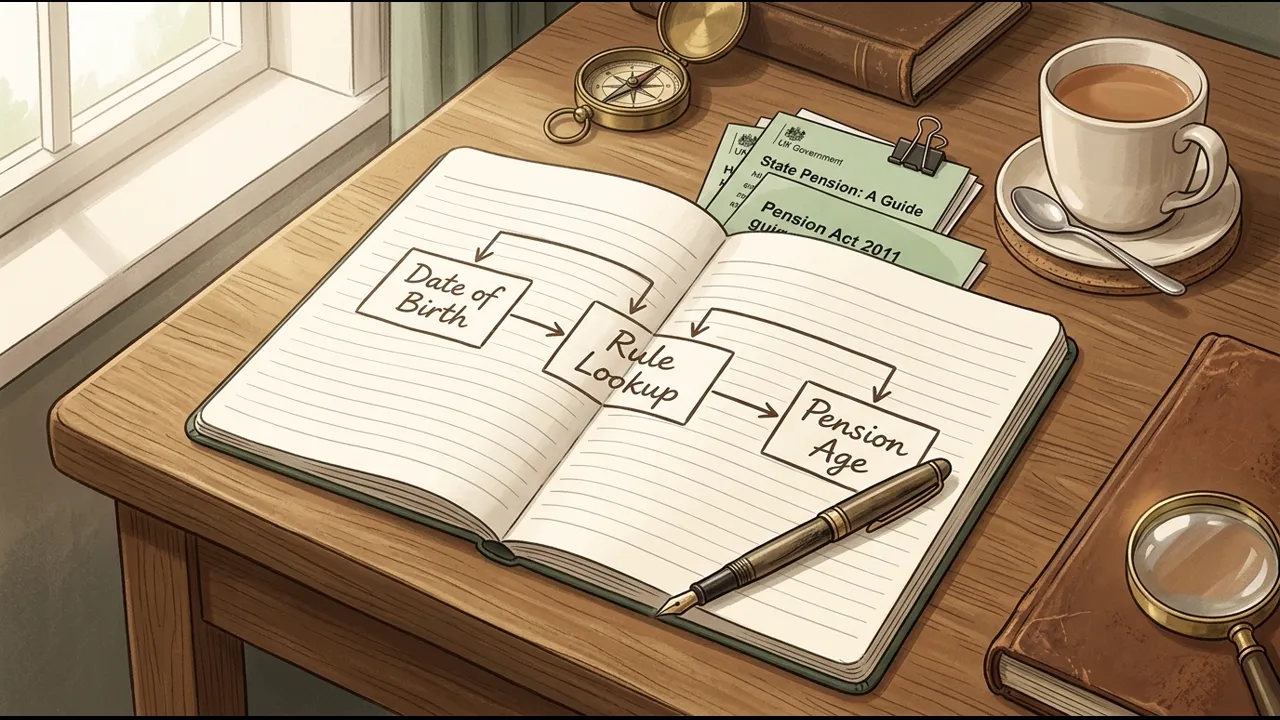
In the UK, your State Pension age is calculated through a statutory cohort matching process rather than an arithmetic formula. Your date of birth is referenced against the primary Acts of Parliament (Pensions Acts 1995, 2007, 2011, and 2014) to determine which legislated phase, cohort threshold, or transitional table applies to you, resulting in your exact legal pension age and the precise calendar date on which you reach it.
Full Gregorian day, month, and year
Pensions Act 1995, 2007, 2011, or 2014
Check if birth falls in phased cohort window
Exact years and months (e.g. 66y 4m or 67y)
Exact calendar day benefit can be claimed
Does Your Date of Birth Determine Your State Pension Age?
Yes. Your date of birth is the central factor used by the UK State Pension age timetable. However, it is essential to frame this accurately: your date of birth does not generate an arbitrary mathematical output; rather, your date of birth is used to identify the State Pension age that applies to you under the relevant legislation and timetable.
Because the law groups people into cohorts based on date ranges, two individuals born relatively close together can potentially fall under different rules, particularly around transition boundaries. For example, a person born on 5 April 1960 has a statutory State Pension age of 66, whereas someone born just one day later on 6 April 1960 falls under the Pensions Act 2014 transitional schedule with an age of 66 years and 1 month.
What Is the UK State Pension Age Timetable?
The UK State Pension age timetable is the statutory schedule enacted across several major Acts of Parliament that defines when different birth cohorts qualify for government retirement payments. Rather than looking up an entire encyclopedic table here (which is covered comprehensively in our State Pension Age by Date of Birth guide), it is helpful to understand the broad phases:
- Equalisation at age 65 (completed November 2018): The Pensions Act 1995 and Pensions Act 2011 phased women's State Pension age from 60 to 65, bringing parity with men.
- The rise to age 66 (completed October 2020): Phased in between March 2019 and October 2020 for both men and women born between 6 December 1953 and 5 October 1954.
- Current baseline of age 66: Everyone born between 6 October 1954 and 5 April 1960 reaches State Pension age on their 66th birthday.
- The transition from 66 to 67 (phasing 2026–2028): Under the Pensions Act 2014, individuals born between 6 April 1960 and 5 March 1961 reach pension age between 66 years and 1 month and 66 years and 11 months.
- State Pension age 67: Everyone born between 6 March 1961 and 5 April 1977 reaches State Pension age on their 67th birthday.
- The scheduled rise to 68 (2044–2046): Under the Pensions Act 2007, an increase from 67 to 68 is legislated for people born from 6 April 1977 onwards, subject to statutory periodic reviews.
Why Isn't State Pension Age Simply 66, 67 or 68?
Many people assume that everyone in the UK retires at a whole-number age like 66, 67, or 68. In reality, four key factors make the calculation far more nuanced:
- Transitional rules: To prevent sudden "cliff edges" where one person qualifies years later than a classmate born a week earlier, Parliament introduces changes gradually in monthly increments.
- Exact calendar dates matter: During phasing periods, the day and month of birth dictate the exact number of added months and the resulting eligibility calendar date.
- Legislation changes over time: Parliament has passed four substantial pension acts over three decades (1995, 2007, 2011, and 2014), each altering or accelerating previous timetables.
- Periodic statutory reviews: The Pensions Act 2014 requires the Secretary of State to review State Pension age at least every six years, considering life expectancy and demographic shifts.
How Transitional State Pension Age Rules Work
Transitional rules are designed as legal bridging mechanisms. When Parliament legislates an increase in the retirement age, moving directly from 66 to 67 on a single day would mean someone born on 6 April would have to wait an entire extra year compared to someone born on 5 April.
To ensure procedural fairness, legislation creates an intermediate schedule where birth dates in consecutive one-month blocks are assigned incremental pension ages:
Is There a Universal Mathematical Formula for State Pension Age?
A frequent question asked by programmers, financial planners, and individuals is: "Can I calculate State Pension age with a mathematical formula like birth_year + 66 or an Excel IF statement?"
The answer is no. There is no universal arithmetic formula. The UK State Pension system is governed by enacted statutes, not continuous mathematical functions. A calculation engine must implement a statutory rule-based lookup for several technical reasons:
- Irregular date boundaries: Statutory cohorts begin and end on specific days of the month (e.g. 6 April to 5 May), reflecting the UK tax year.
- Transitional calendar anomalies: Adding months to calendar dates can result in invalid dates (e.g. adding 4 months to 31 July produces 31 November, an impossible date). Section 26(7A) of the Pensions Act 2014 specifically creates statutory exceptions for births on 31 July, 31 December, and 31 January, setting their eligibility date to the final day of the preceding month.
- Future statutory modifications: A mathematical formula cannot accommodate parliamentary amendments or new primary legislation without rewriting the entire equation.
How Our Pensionable Age Calculator Works
The Pensionable Age Calculator on Age Calculator Lab performs a five-step evaluation in your browser without transmitting any private data across the network:
- Step 1 — Input validation: Parses your Gregorian date of birth and ensures valid day, month, and year inputs.
- Step 2 — Governing Act identification: Determines whether your birth date is governed by the Pensions Act 1995, 2007, 2011, or 2014.
- Step 3 — Phasing & transition check: Evaluates whether your birth date falls inside a transitional range (such as the 1960–1961 monthly phasing schedules).
- Step 4 — State Pension age assignment: Retrieves the exact qualifying age in years and months (e.g., exactly 66, 66 years 4 months, or 67).
- Step 5 — Calendar eligibility projection: Projects the exact future calendar date when you achieve that statutory milestone, accounting for leap years and end-of-month legal boundaries.
How Is the State Pension Eligibility Date Calculated?
It is vital to distinguish between your State Pension age (expressed in years and months) and your State Pension eligibility date (a specific calendar day):
- For whole-year cohorts (e.g. age 66 or 67): Your eligibility date is normally your birthday in that qualifying year. For example, if you were born on 15 May 1970 and your pension age is 67, your eligibility date is 15 May 2037.
- For transitional cohorts: Your eligibility date is determined directly by Schedule 12 Table 3 of the Pensions Act 2014. Rather than simply adding months to your birth date, the statute assigns a specific eligibility month or day based on your birth bracket.
Worked Example 1: Standard Whole-Year Calculation
Input: Date of birth: 15 May 1970
- Step 1: Evaluation against statutory cohort tables.
- Step 2: 15 May 1970 falls into the cohort born 6 March 1961 – 5 April 1977.
- Step 3: Governing legislation: Pensions Act 2014, Section 26.
- Step 4: Applicable State Pension age: 67 years.
- Step 5: Calendar eligibility date: 15 May 2037 (your 67th birthday).
Status verified under current UK legislation as of September 2026.
Worked Example 2: Transitional Phased Calculation
Input: Date of birth: 15 May 1960
- Step 1: Evaluation against statutory cohort tables.
- Step 2: 15 May 1960 falls in the transitional range: 6 May 1960 – 5 June 1960.
- Step 3: Governing legislation: Pensions Act 2014, Schedule 12, Table 3.
- Step 4: Applicable State Pension age: 66 years, 1 month.
- Step 5: Statutory eligibility date: 15 June 2026.
Transitional cases require the detailed statutory lookup table rather than an approximation.
Does State Pension Age Depend on Gender?
No. Under current UK law, State Pension age does not depend on whether you are male or female.
Historically, women had a State Pension age of 60 while men had an age of 65. The Pensions Act 1995 and Pensions Act 2011 introduced a timetable to equalize pension ages. Equalization was fully achieved in November 2018 when women's pension age reached 65. Since October 2020, both men and women have shared identical State Pension ages (initially 66, rising to 67 and 68). Today, gender is not an input in any UK State Pension age calculation.
Can State Pension Age Change in the Future?
Yes. The UK State Pension age is not permanent or unalterable. It is established by Act of Parliament and can be amended whenever Parliament passes new primary legislation.
To ensure policies remain sustainable as demographics evolve, the Pensions Act 2014 requires an independent State Pension Age Review at least once every six years. These reviews evaluate:
- Life expectancy projections produced by the Office for National Statistics (ONS).
- Socioeconomic factors, including regional health inequalities and workforce participation.
- Fiscal sustainability of government expenditure on pensions.
It is important to remember that independent review recommendations or government proposals do not alter your legal pension age until enacted by Parliament.
Current Legislated Rules vs Future Changes
Understanding where a policy stands in the legislative process helps you avoid planning around unconfirmed rumors:
| Legal Status | Official Meaning | Planning Impact |
|---|---|---|
| Current Law | Enacted Acts of Parliament currently in legal force. | The baseline you should use for current financial planning and benefit estimates. |
| Scheduled Increase | Increases already enacted in existing statutes for future dates (e.g. rise to 67 in 2026–2028). | Statutory certainty unless Parliament passes an amending Act to alter the date. |
| Statutory Review | Periodic independent report analyzing life expectancy and recommending future policy options. | Informational only; does not change legal eligibility dates. |
| Government Proposal | A ministerial white paper or consultation outlining potential future legislation. | Subject to debate, consultation, and revision; cannot be relied upon until passed. |
| Enacted Legislation | A Bill passed by both Houses of Parliament and granted Royal Assent. | Becomes the new statutory timetable and updates official calculation engines. |
Does State Pension Age Tell You When You Can Retire?
No. State Pension age does not dictate when you retire from employment.
As explored in detail in our comparison guide, State Pension Age vs Retirement Age: What's the Difference?, retirement is an elective life transition, whereas State Pension age is a statutory benefit qualification date. The UK abolished the default retirement age in 2011. You are legally entitled to stop working at 55 using personal savings, or continue working full-time well past 70 while receiving your State Pension.
Does State Pension Age Tell You How Much Pension You'll Get?
No. Your State Pension age calculation tells you when you qualify, not how much money you will receive.
The monetary amount of your UK State Pension is determined by your personal National Insurance (NI) record:
- Under the new State Pension system (for people reaching pension age on or after 6 April 2016), you typically need at least 10 qualifying years of National Insurance contributions or credits to receive any State Pension at all.
- To receive the full new State Pension, you generally need 35 qualifying years (subject to transitional deductions for pre-2016 contracting out).
- Age Calculator Lab calculates your legal age and milestone date, but does not calculate entitlement sums. For your personalized forecast, consult the official GOV.UK State Pension forecast service ↗.
State Pension Age Calculation vs State Pension Forecast
| Your Question | What You Need | Where to Find It |
|---|---|---|
| What is my legal State Pension age? | Statutory cohort lookup based on date of birth. | Pensionable Age Calculator / GOV.UK |
| On what exact calendar date can I claim? | Gregorian calendar milestone calculation. | Pensionable Age Calculator |
| How much money will I receive each week? | Audit of lifetime National Insurance contributions. | GOV.UK State Pension forecast ↗ |
| Do I have gaps in my National Insurance record? | Detailed tax-year contribution breakdown. | GOV.UK NI Record ↗ |
| How do I submit my claim to the Pension Service? | Official claim invitation letter or online portal. | GOV.UK: Claim State Pension ↗ |
Common State Pension Age Calculation Mistakes
When working out State Pension age independently, individuals frequently make these eight common errors:
1. Using only the birth year
Ignoring your birth month and day leads to errors, especially around tax-year cohort cutoffs like 5 April.
2. Assuming everyone reaches pension age at 66
Age 66 is current for older cohorts, but millions born after 5 April 1960 have ages of 66y 1m to 67 or 68.
3. Assuming a single uniform age for a decade
People born in 1960 or 1961 do not share the same pension age; monthly phasing applies across those years.
4. Ignoring transitional rules
Attempting to jump directly from 66 to 67 overlooks the 11 intermediate statutory cohorts in the Pensions Act 2014.
5. Using an outdated timetable
Relying on old information from the 1995 or 2007 Acts without incorporating the 2011 and 2014 accelerations.
6. Confusing pension age with retirement age
Assuming you must stop working on the day you reach State Pension age, or that retiring early unlocks payments.
7. Confusing State Pension with private pensions
Conflating State Pension age with the Normal Minimum Pension Age (NMPA) for private pensions (55, rising to 57 in 2028).
8. Assuming pension age guarantees full payments
Failing to realize that payment amounts depend on your personal National Insurance record, not your age alone.
Calculate Your Exact State Pension Age and Date
Get an instant, private calculation based on the current UK statutory timetable. Enter your date of birth to see your exact qualifying age, calendar eligibility milestone, and governing legislation.
Related Pension & Retirement Calculators
Age Calculator Lab provides dedicated, privacy-first tools for different aspects of your retirement chronology:
Pensionable Age Calculator
Calculates your statutory UK State Pension age and qualifying calendar date from your date of birth under enacted legislation.
Pension Age Date Calculator
Calculates the future calendar date when you reach any specified pension age (e.g. scheme normal retirement age 60 or 65).
Retirement Age Calculator
Models elective retirement dates, career horizons, and countdowns based on your target retirement milestone.
Early Retirement Date Calculator
Determines your target retirement date when planning an early exit ahead of statutory pension milestones.
Related State Pension Guides
Explore our complete cluster of educational guides on UK pension rules and retirement chronology:
- What Is Pensionable Age? Pensionable Age vs Retirement Age Explained — Foundational concepts of statutory pension ages, NMPA rules, and scheme frameworks.
- UK State Pension Age by Date of Birth: Complete Guide — Comprehensive cohort timetables covering 1960, 1961, 1970, and 1978 birth groups.
- When Can I Get My State Pension? How to Check Your State Pension Age — Step-by-step claiming roadmap, invitation letters, forecast checks, and deferral options.
- State Pension Age vs Retirement Age: What's the Difference? — Clear comparison between legal benefit eligibility, personal retirement autonomy, and private pensions.
- Can I Retire Before State Pension Age? Early Retirement in the UK Explained — How early retirement differs from statutory State Pension age, bridging the gap, and pension access rules.
Frequently Asked Questions About State Pension Age Calculation
How is State Pension age calculated in the UK?
Your UK State Pension age is determined primarily by your date of birth and the State Pension age timetable enacted in legislation (Pensions Acts 1995, 2007, 2011, and 2014). It is evaluated using statutory cohort schedules and transitional lookup rules rather than a single arithmetic formula.
Does State Pension age depend on date of birth?
Yes. Date of birth is the central factor used by the State Pension age timetable. Your exact day, month, and year of birth map into specific statutory cohorts that determine your legal State Pension age.
Is there a formula for State Pension age?
No. There is no simple arithmetic formula like "birth year + 66". State Pension age is defined by legal boundary schedules and transitional tables enacted by Parliament. It is a statutory rule-based lookup, not a mathematical equation.
Why do some people have a transitional State Pension age?
When Parliament increases the State Pension age (such as from 66 to 67, or previously from 65 to 66), transitional rules are applied to prevent adjacent birth cohorts from experiencing sudden multi-year jumps. Instead, qualifying ages increase incrementally month by month.
Can my State Pension age change?
Yes. Under UK law, the government conducts periodic reviews of State Pension age at least once every six years. However, any proposed change requires new primary legislation to be passed by Parliament before taking legal effect.
How do I calculate my State Pension age?
You can calculate your exact State Pension age and calendar eligibility date using the free Pensionable Age Calculator on Age Calculator Lab, which applies the verified legislated timetable to your date of birth.
Is State Pension age the same as retirement age?
No. State Pension age is the statutory date when government pension payments can first begin. Retirement age is a personal or workplace milestone when you stop working. You can retire before or continue working long after reaching State Pension age.
Does State Pension age tell me how much pension I will receive?
No. State Pension age only determines when you can claim. The weekly payment amount depends on your lifetime National Insurance contribution record. Check your official State Pension forecast on GOV.UK for monetary projections.
Can I retire before State Pension age?
Yes. You can stop working whenever your personal finances allow. However, your State Pension will not be paid until you reach your statutory State Pension age; you must fund early retirement through personal savings, ISAs, or private pensions.
How can I check my exact State Pension age?
You can check your exact State Pension age using our Pensionable Age Calculator or the official GOV.UK State Pension age checker tool online.
Does my birth month matter?
Yes, especially during transitional phasing periods. For example, individuals born between 6 April 1960 and 5 March 1961 have their State Pension age phased from 66 years and 1 month to 66 years and 11 months depending on their exact birth month.
Official UK State Pension Sources
To verify statutory schedules, calculate personal entitlement figures, or obtain official government forecasts, consult these verified primary portals:
- GOV.UK: Check your State Pension age — The official government tool for checking statutory qualifying dates.
- GOV.UK: Check your State Pension forecast — Review your lifetime National Insurance record and estimated weekly payout.
- Pensions Act 2014, Schedule 12 — Primary legislation establishing the transition timetable from age 66 to 67.
- GOV.UK: State Pension Age Review — Official publications and reports on periodic statutory reviews.
- MoneyHelper (Money and Pensions Service) — Free, impartial, government-backed guidance on workplace and personal retirement planning.
Age Calculator Lab is an independent calculator and informational website. It is not affiliated with, endorsed by, or operated by the UK Government or the Department for Work and Pensions (DWP). This guide is for educational purposes only and does not constitute financial, investment, or legal advice. Pension rules can change following statutory reviews. Check GOV.UK before making financial or retirement decisions.
Methodology & Trust
At Age Calculator Lab, our State Pension calculation logic applies the exact statutory schedules enacted by the UK Parliament. Our calculation engine verifies cohort cutoffs against statutory schedules, accounts for transition windows down to the exact month and day, and respects Gregorian leap-year and end-of-month legal boundaries.
Rules last verified: September 2026. Pension rules and statutory age schedules are subject to periodic parliamentary reviews and potential future legislation. We recommend verifying individual contribution records and official forecasts via GOV.UK before committing to permanent retirement decisions.