

Quick answer
100 days old is reached by adding 100 days to the birth date. A baby born 1 January 2026 is 100 days old on 11 April 2026 (a Saturday); a baby born 15 March 1990 reached 100 days on 23 June 1990 (a Saturday); a leap-day baby born 29 February 2024 reached 100 days on 8 June 2024.
The baek-il tradition
The baek-il (백일) marks the first 100 days of a child’s life. Its roots lie in a time when infant mortality was high and reaching 100 days was a genuine milestone of survival — worth marking with family, food and gifts. In pre-modern Korea, making it past 100 days was taken as an indicator the child would live to at least its first birthday.
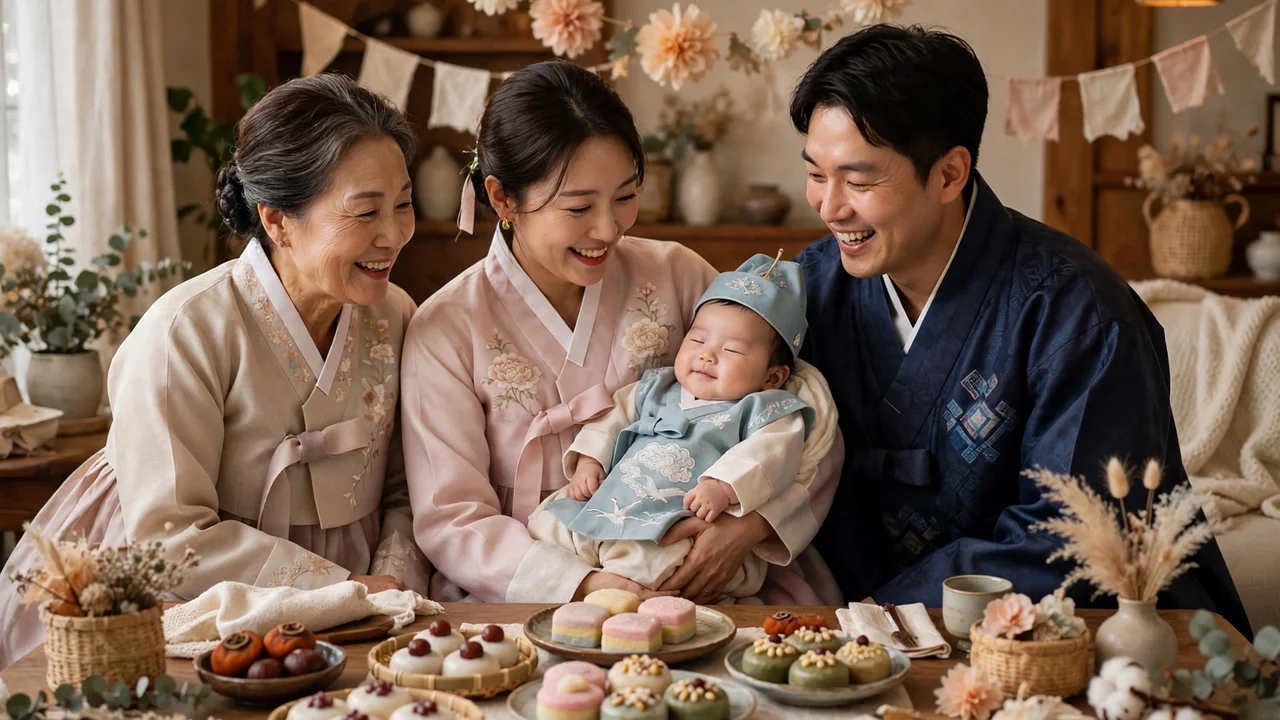
The celebration is traditionally a family gathering with rice cakes (baekseolgi) and, in modern practice, a party and photographs. The first birthday, the dol (돌), is the larger celebration a year later, with the doljabi ritual of choosing an object said to predict the child’s future. The baek-il and the dol are the two traditional milestones of a Korean baby’s first year.
The ritual: Samsin, rice cakes and 100 people
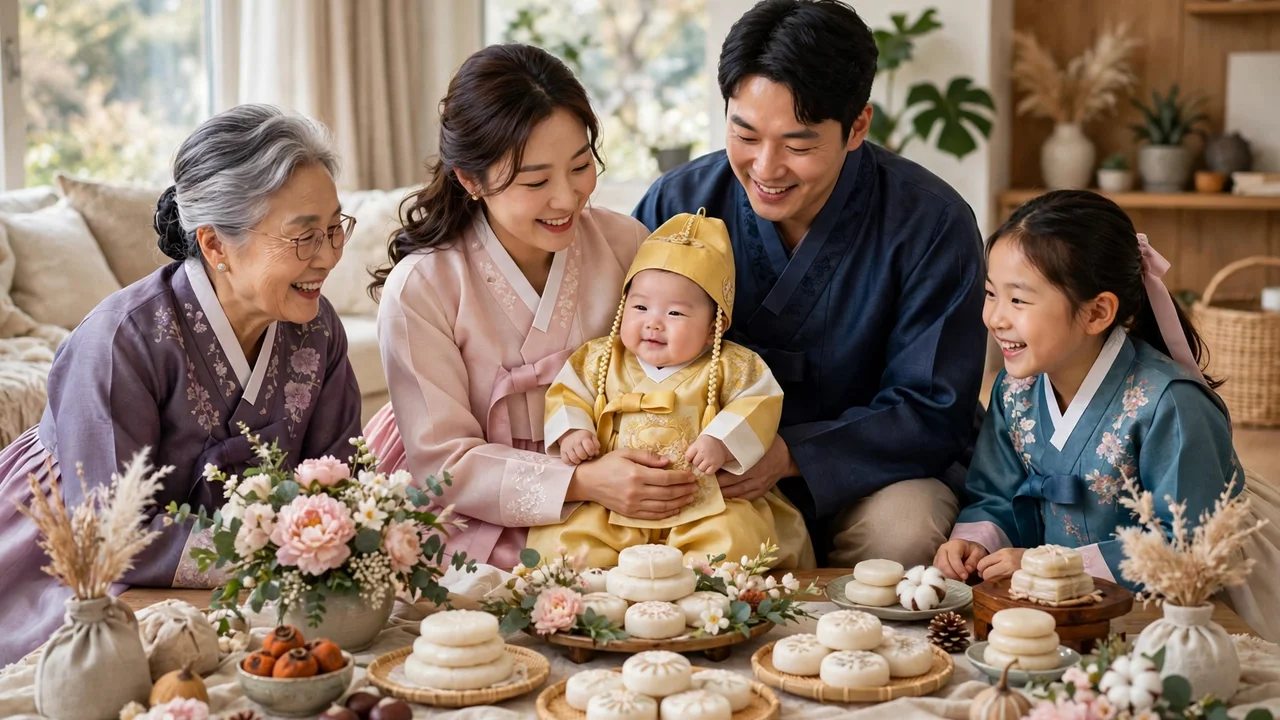
During the baek-il, the family worships Samsin, the birth goddess, with offerings of rice and soup — thanks for caring for infant and mother through a difficult period, and prayers for jae-ak (wealth), longevity and chobok (luck). After the prayer, family, relatives and friends celebrate with rice cakes, wine and delicacies such as red and black bean cakes sweetened with sugar or honey.
Two details carry the meaning. Red bean rice cakes are placed at the four compass points of the house to protect the child and bring good fortune. And the rice cakes are meant to be shared with 100 people — widely believed to give the child a long life — with neighbours and others returning the dishes with lengths of thread (hope for longevity), rice and money (future wealth). The white rice cake itself is a pun: baek (白, white) on baek (百, hundred), a wish for a hundred years of life.
The same milestone across East Asia
The custom is regional, not uniquely Korean. In China it is the bai ri yan (百日宴), the “hundred-day banquet”. In Vietnam, the le thoi noi at approximately 100 days marks the same milestone. Counterparts exist in Manchuria and Japan. Across all of them, the logic is the same: the first three months were the most vulnerable period, and reaching 100 days deserved community recognition.
In contemporary diaspora communities — Korean, Chinese and Vietnamese families in the US, Canada, UK and Australia — the ceremony remains widely observed, often as a full celebration with hanbok, professional photographs and a gathering of extended family.
The other baek-il: couples and the 100-day count
The same number marks Korean couple culture: 100일 is the first real milestone of a relationship, followed by 200일, 300일, 500일 and 1000일. And here the counting matters: couples count inclusively — the day dating started is Day 1, so the hundredth day is the start date plus 99 days. Every Korean D-day app is built on this rule.
That inclusive counting is the opposite of what Korean law does: article 157 of the Civil Act drops the first day when computing a period. The baby’s baek-il is counted the same inclusive way in tradition, which is why sources differ by a day: the tool on this site adds 100 days (birth day as day zero), while an inclusive count gives one day earlier. State the convention when inviting people, and the confusion disappears.
How the date is found
Add 100 days to the birth date. That is the whole method, and it is the same convention used by the milestone-days series on this site: the birth day is day zero, and the count adds calendar days. Leap days inside the span are simply counted as days.
The confusion comes from counting the birth day as day one, which shifts the date one day earlier. If another source gives a date one day before this guide’s, it is counting inclusively.
Worked examples
Born 1 January 2026: add 100 days → 11 April 2026, a Saturday. Born 15 March 1990: add 100 days → 23 June 1990, a Saturday. Born 29 February 2024 (a leap day): add 100 days → 8 June 2024. In each case the weekday is given because celebrations are planned for weekends, and the weekday of a 100-day date is not predictable without counting.
Planning the celebration
Book the venue for the weekend nearest the exact date rather than moving the date itself — the tradition honours the day, and guests understand a weekend shift. Photographs matter more than decoration at this age: the baby will not remember the party, but the family will keep the pictures. Keep the guest list small if the baby is still on a short sleep cycle; a two-hour gathering beats a four-hour one. And if you honour the sharing custom, the rice cakes for neighbours are the part guests remember longest.
Common mistakes to avoid
Counting the birth day as day one (one day early); using “three months” as a substitute for 100 days (months vary in length, so the date shifts); confusing the baek-il with the dol and its doljabi ritual (that belongs to the first birthday); and assuming the date is the same as the 100-day mark in another country’s tradition without checking the convention.
Related calculators
Use the 100 Days Old Calculator for the exact date, and the other milestone tools for the dates around it.



Frequently asked questions
What is the baek-il?
The Korean celebration of a baby’s first 100 days, traditionally marked with family, rice cakes and prayers to Samsin, the birth goddess.
Why 100 days?
In pre-modern Korea, infant mortality was highest in the first three months. Reaching 100 days was taken as an indicator the child would live to its first birthday.
What happens at a baek-il?
Offerings of rice and soup to Samsin, prayers for wealth, longevity and luck, red bean cakes at the four compass points of the house, and rice cakes shared with 100 people.
Why share cakes with 100 people?
It is widely believed to give the child a long life. Recipients return the dishes with thread (longevity), rice and money (wealth).
How is the 100-day date calculated?
By adding 100 days to the birth date, with the birth day counted as day zero. Inclusive counting (birth day as day one) gives one day earlier.
Why do some sources give a date one day earlier?
They count the birth day as day one (inclusive counting) instead of day zero. The one-day difference is a convention, not an error in either direction.
When is a baby born 1 January 2026 100 days old?
11 April 2026, a Saturday.
What comes after the baek-il?
The dol, the first birthday, a year later — the larger of the two traditional Korean first-year celebrations, with the doljabi ritual.
Do other cultures celebrate 100 days?
Yes. China has the bai ri yan (hundred-day banquet) and Vietnam the le thoi noi, with the same survival logic.
Is 100 days the same as three months?
No. Months vary in length, so three months after a birth date is rarely exactly 100 days later.