
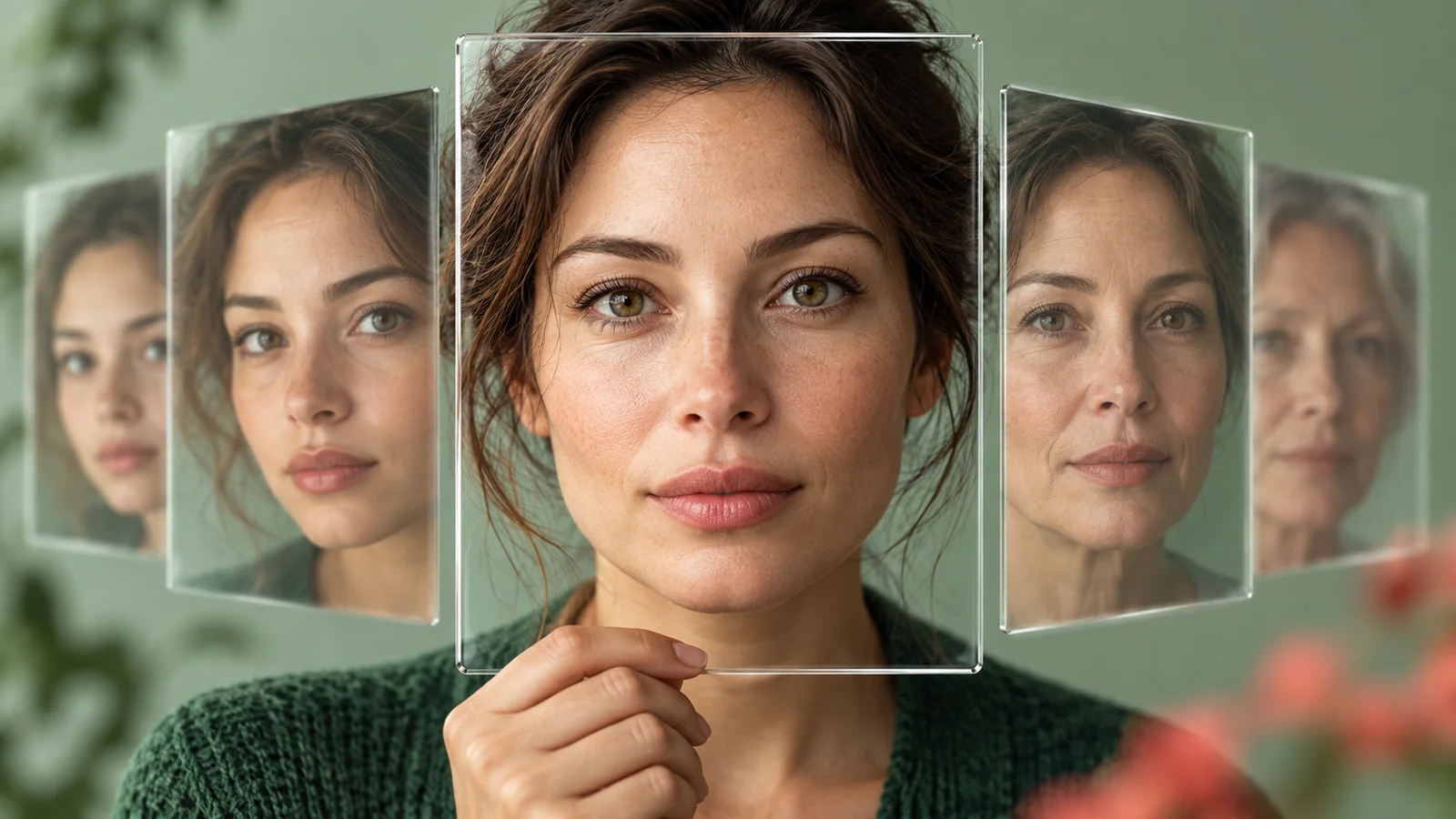
Introduction: Understanding Face Age Accuracy
If you've ever used a face age calculator and received an age that seemed surprisingly high or low, you may have wondered how accurate the result really is. A photograph contains many visual clues that can influence perceived age, but those clues don't provide a direct measurement of your chronological age.
Face-age calculators are designed to estimate apparent age from a photograph. Their results can be affected by lighting, camera angle, facial expression, image quality, visible skin characteristics and the methodology used by the particular system. You can explore an apparent-age estimate using our verified face age calculator directly in your browser.
In this guide, we'll explain what face-age accuracy actually means, why different photos can produce different results, what factors influence an estimate, and how to interpret a face-age result without treating it as an exact measurement.
Are Face Age Calculators Accurate?
Face-age calculators can provide useful estimates of apparent age, but they should not be expected to determine someone's exact chronological age from a photograph.
To evaluate these tools objectively, it is crucial to separate four distinct engineering and mathematical concepts:
- Accuracy: How closely an estimated figure matches an underlying real-world ground truth (such as chronological age).
- Precision: How tightly grouped a series of repeated measurements are under identical conditions.
- Consistency: Whether the algorithm produces similar outputs across comparable portrait images.
- Appearance Estimation: Evaluating outward visual characteristics to deduce how old someone appears in a specific photograph.
Important Distinction: A result displaying “Estimated face age: 34” does not mean “Your actual age is 34.” It indicates that the photograph's optical features align with statistical appearance patterns typical of individuals around that age.
What Does “Accuracy” Mean for Face Age Estimation?
When users discuss accuracy, they often assume a single universal metric. In computer vision and biometrics, however, accuracy involves three distinct dimensions:
1. Exactness (Proximity to Chronological Age)
Exactness measures how close an estimate lands to someone's certified calendar birth date. Because genetics, sleep, sun exposure, and lifestyle create wide appearance variations, two 40-year-olds may genuinely possess naturally different outward facial ages.
2. Consistency (Stability Across Similar Images)
Consistency evaluates whether an algorithm generates predictable results when given comparable photographs captured under similar illumination and perspective.
3. Apparent-Age Relevance (Faithfulness to the Image)
Relevance asks whether the estimate reflects how the person genuinely appears in that specific photograph. If someone is exhausted under harsh downward light, a higher apparent-age estimate accurately captures the image's visual reality, even if it diverges from their chronological age.
| Scenario | Chronological Age | Estimated Face Age | Visual Explanation |
|---|---|---|---|
| Subject A (Rested, Soft Light) | 40 years | 36 years | Diffused lighting softens micro-shadows and lines |
| Subject A (Fatigued, Harsh Light) | 40 years | 42 years | Overhead contrast amplifies tear troughs and nasolabial folds |
This variance does not mean the system is broken; it reflects the differing optical information present in each photograph.
Why Can a Face Age Calculator Give Different Results? (8 Key Factors)
A computer vision model only knows what the image pixels convey. Eight major environmental and styling factors influence what an algorithm detects:
Lighting Direction and Softness
Soft, diffused illumination renders facial surfaces smoothly. In contrast, hard directional or overhead light casts deep downward shadows beneath the brow, nose, and jawline, exaggerating facial creases.
Camera Angle and Elevation
A front-facing, eye-level portrait maintains true craniofacial proportions. High angles slim the lower face, while upward angles exaggerate under-chin tissue.
Facial Expression and Muscle Tension
Smiling, squinting, or laughing contracts dynamic facial muscles, creating temporary crow's feet and cheek contours that shift apparent age.
Image Quality and Resolution
Blurry, pixelated, or compressed images obscure landmark features, forcing models to rely on coarse geometric approximations.
Cosmetics and Skin Preparation
Foundations, concealers, and contouring powders modify skin reflectance and conceal micro-shadows, significantly altering optical signals.
Hairstyle and Facial Framing
Bangs conceal forehead lines, while voluminous hair frames the jawline differently. Facial hair can also obscure lower-face contours.
Filters and Digital Post-Processing
Social media beauty filters artificially smooth dermal textures, enlarge pupils, and reshape jaws, invalidating natural biometric landmarks.
Occlusion and Obstruction
Sunglasses, masks, hats, stray hair strands, or hands resting on the chin block essential facial landmarks, reducing model reliability.

Can Two Photos of the Same Person Have Different Face Ages?
Yes. Two photographs of the same individual taken on the same afternoon can easily produce estimates that differ by 4 to 8 years.
| Photograph | Photographic Conditions | Algorithmic Interpretation |
|---|---|---|
| Photo A | Even daylight, eye-level, neutral expression | Balanced landmark geometry $ ightarrow$ Baseline estimate (e.g., 34) |
| Photo B | Harsh side lighting, downward angle | Deep shadow contrast on cheek planes $ ightarrow$ Older estimate (e.g., 39) |
| Photo C | Dynamic smile, warm ambient lighting | Contracted eye muscles $ ightarrow$ Distinct estimate (e.g., 36) |
Crucial Principle: The person has not become older or younger between the photographs. The visual representation has changed. A face-age estimate belongs to the photograph as much as it belongs to the individual.
Does AI Know Your Real Age?
No. Artificial intelligence cannot magically extract your date of birth simply by looking at facial pixels.
It is helpful to visualize the fundamental divergence in processing:
Photograph $ ightarrow$ Optical Pixel Data $ ightarrow$ Computer Vision Analysis $ ightarrow$ Estimated Apparent Age
Certified Date of Birth $ ightarrow$ Calendar Calculation $ ightarrow$ Exact Chronological Age
These are fundamentally different operations. One is an optical interpretation; the other is a mathematical calculation.
How AI Age Estimation Can Work
For an in-depth breakdown of the underlying vision architecture, read our complete guide to how face age estimation works. In summary, automated tools follow five consecutive steps:
- Image Input: The digital file is parsed into raw pixel tensors.
- Face Localization: Bounding algorithms locate and crop the face.
- Landmark Alignment: Eye, nose, and jaw coordinates are normalized.
- Feature Processing: Proportions, textures, and contour vectors are extracted.
- Statistical Mapping: Regression models estimate apparent age.
Methodology Note: Different age-estimation systems employ different neural network topologies, training corpuses, and loss functions. Consequently, there is no single universal formula for determining face age from an image.
What Factors Can Make You Look Older or Younger in Photos?
Perceived age in a photograph is a composite impression shaped by interconnected visual variables:
- Illumination angle and contrast ratios
- Facial expression and eye animation
- Micro-texture distribution and skin hydration
- Camera distance and focal length perspective
- Hairstyle, hair volume, and hairline framing
- Cosmetics, skin contouring, and mattifying products
- Shadow patterns around the jawline and neck
- Sensor noise, sharpening filters, and compression artifacts
Face Age vs Chronological Age
Chronological age and apparent face age answer two entirely different questions. You can calculate your actual age down to the exact day with our verified calculator.
| Measurement | What It Tells You | Primary Determination |
|---|---|---|
| Chronological Age | How much calendar time has passed since birth | Certified date of birth (DOB) |
| Face (Apparent) Age | How old someone appears in a specific photograph | Visible facial features & optical conditions |
| Biological Age | Physiological state of cellular & organ systems | Clinical biomarkers & epigenetic clocks |
Someone could possess a chronological age of 45 and receive an estimated face age of 40 in a well-lit photo. That does not mean their body is biologically 40.
Face Age vs Biological Age
Another common misconception is equating facial appearance with internal biological health. Explore our biological age calculator to see how lifestyle and physiological markers are evaluated.
- Face Age: Strictly concerned with superficial optical appearance in a picture.
- Biological Age: Evaluates physiological biomarkers, telomere lengths, DNA methylation rates, and cardiovascular efficiency.
Medical Disclaimer: A photograph alone should never be treated as a medical assessment of biological aging, cardiovascular risk, or physiological health.
How to Get a More Reliable Face Age Estimate
Rather than seeking guaranteed accuracy, focus on providing better-quality input for more stable, reproducible results.
✓ Recommended Practices (DO)
- Use clear, high-resolution photos: Avoid blurry or heavily cropped shots.
- Ensure even, balanced lighting: Soft natural daylight facing a window is ideal.
- Keep your entire face visible: Pull hair back and remove tinted glasses.
- Maintain a neutral expression: Relax your forehead, eyes, and jaw.
- Position camera at eye level: Avoid extreme high or low angles.
- Use uncompressed originals: Avoid social media screenshots.
✕ Conditions to Avoid (AVOID)
- Heavy beauty filters: Do not use smoothing or face-slimming presets.
- Harsh overhead downlights: Avoid spotlights casting deep dark shadows.
- Extreme head tilts: Avoid three-quarter or profile angles.
- Sunglasses or face coverings: Keep all primary landmarks unobstructed.
- Excessive photo editing: Avoid unnatural contrast and saturation boosts.
- Group photos: Ensure only one clear face is present in the frame.
Are All Online Face Age Calculators the Same?
No. Different online face-age estimators can return noticeably different estimates from the exact same image.
Discrepancies occur because systems differ in:
- Underlying Models: Classic geometric landmark regressions vs. deep convolutional networks.
- Training Datasets: Varying demographic representations across ethnicities, age groups, and illumination conditions.
- Preprocessing Routines: Differing color normalization, contrast equalization, and cropping boundaries.
- Client vs Server Architecture: In-browser processing models vs high-capacity server-side neural models.
Should You Trust a Face Age Result? (Responsible Use Framework)
To interpret face-age calculator outputs responsibly, apply this 3-tier interpretation framework:
Useful Interpretation
- Approximate visual maturity indicator
- Fun visual exploration & curiosity
- Understanding lighting impact on portraits
- Evaluating camera perspective differences
Use With Caution
- Comparing photos from different days
- Evaluating skincare or aesthetic changes
- Drawing conclusions about overall appearance
Do Not Use As
- Proof of legal or chronological age
- Medical or clinical diagnosis
- Biological aging measurement
- Identity verification or compliance screening
When Should You Use a Face Age Calculator?
Photo-based age estimators are excellent for curiosity, entertainment, understanding computer vision, and experimenting with how illumination and angles transform portraits. They are not intended for civil age verification, medical diagnosis, or employment screening.
Explore Your Estimated Face Age
Curious about how old you appear in a photo? Upload a clear, well-lit portrait to our verified Face Age Calculator and explore an approximate apparent-age estimate processed privately in your browser.
Try the Face Age Calculator →Frequently Asked Questions
How accurate are face age calculators?
They provide useful estimates of apparent age based on visible image characteristics, but should not be expected to determine exact chronological age.
Can AI accurately guess someone's age?
AI models estimate apparent age within a statistical range, but results depend heavily on lighting, expression, and image quality.
Why does my face age change between photos?
Lighting, camera angle, facial expression, and resolution change the optical information received by the algorithm, causing estimates to fluctuate.
Can a photo make you look older?
Yes. Harsh downward shadows, tired eyes, squinting expressions, and unflattering angles can make you appear several years older in pictures.
Can a face age calculator determine my real age?
No. Real age is determined strictly by date of birth, which cannot be extracted from photo pixels.
Is face age the same as biological age?
No. Face age concerns superficial visual appearance, while biological age describes internal physiological health.
Why do different age calculators give different results?
Different tools use different machine-learning models, training datasets, and facial-landmark definitions.
Can face age estimation be used for age verification?
No. Apparent-age estimation is probabilistic and cannot replace legal identification credentials.
How can I get a better face-age estimate?
Use a clear, evenly lit, eye-level photo with a neutral expression and minimal filters.
Conclusion: A Matter of Appearance, Not Measurement
Face-age calculators can be useful for exploring apparent age, but their results should be interpreted as estimates rather than exact measurements. A photograph contains many variables—including lighting, expression, camera angle and image quality—that can influence how old someone appears.
The most important distinction is between face age and chronological age. A photo-based estimate describes appearance in a particular image; it does not determine your actual age or biological age. If you are curious, explore our Face Age Calculator with a clear portrait and read our guide on how old do I look for more insights.
Reviewed & Methodology
Reviewed by: Navjeet Kamboj
Focus: Face-age estimation terminology, calculator interpretation, precision limits, and responsible algorithmic use.
Last reviewed: October 3, 2026
Methodological Notice: Apparent-age estimates are probabilistic and developed solely for informational and educational use. They do not constitute civil age verification, identity validation, or clinical diagnoses.
